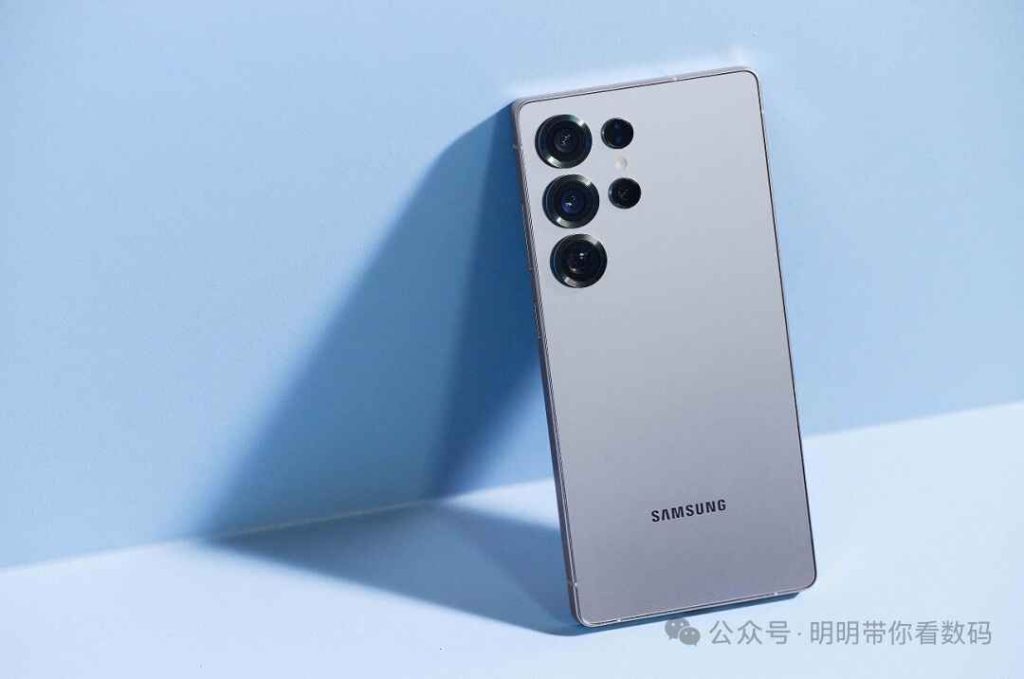

If you’re considering buying a true flagship phone and wondering if the Samsung Galaxy S25 Ultra is worth your hard-earned money, you’ve come to the right place. In this Samsung Galaxy S25 Ultra review, I’ll delve beyond the specs, share my hands-on experience, and provide clear conclusions—so you can make an informed decision.
First Impressions and New Features
Design and Feel
From the moment I picked up the Galaxy S25 Ultra, I noticed its exquisite craftsmanship. The ultra-narrow bezels and titanium body give it a premium feel, and its weight of approximately 218 grams (compared to approximately 233 grams in its predecessor) is a significant difference.
One noteworthy detail: the S Pen is still present, but its motion-sensing functionality has reportedly been removed.
In short: its look and feel are superb. However, if you previously used the previous generation Ultra, you might not find the dramatic design changes immediately apparent.
Screen and Hardware Highlights
The Galaxy S25 Ultra features a 6.9-inch QHD+ Dynamic AMOLED display with a 120Hz refresh rate.
It also comes with upgraded protective glass—Corning Gorilla Glass 2—which is said to withstand drops from approximately 2.2 meters.
Hardware-wise: This phone uses the Snapdragon 8 Elite (Galaxy version) chip, supports Wi-Fi 7 and UWB, and boasts excellent heat dissipation (through an enlarged liquid cooling system).
So, yes, in a purely technical sense, its hardware configuration is flagship-level. But as some reviewers have pointed out, the so-called “major” improvements compared to last year are actually only incremental.
Specifications
| Body dimensions | 5.78 x 2.78 x 0.28 in |
| Weight | 162 gm |
| SIM | Nano-SIM + Nano-SIM + eSIM + eSIM (max 2 at a time) |
| Display type | Dynamic LTPO AMOLED 2X, 120Hz, HDR10+, 2600 nits (peak) |
| Display size | 6.2 inches, 94.4 cm2 (~91.1% screen-to-body ratio) |
| Resolution | 1080 x 2340 pixels, 19.5:9 ratio (~416 ppi density) |
| OS | Android 15, up to 7 major Android upgrades, One UI 7 |
| Chipset | Qualcomm SM8750-AB Snapdragon 8 Elite (3 nm) |
| Internal memory | 128GB (up to 512 GB) 12GB RAM, UFS 4.0 |
| Cameras | 50 MP, f/1.8, 24mm (wide), 1/1.56″, 1.0µm, dual pixel PDAF, OIS 10 MP, f/2.4, 67mm (telephoto), 1/3.94″, 1.0µm, PDAF, OIS, 3x optical zoom 12 MP, f/2.2, 13mm, 120˚ (ultrawide), 1/2.55″ 1.4µm, Super Steady video |
| Camera features | Best Face, LED flash, auto-HDR, panorama |
| Sensors | Fingerprint (under display, ultrasonic), accelerometer, gyro, proximity, compass, barometer |
| Battery type | Li-Ion 4000 mAh |
| Charging | 25W wired, PD3.0, 50% in 30 min |
| Colours | Icy Blue, Mint, Navy, Silver Shadow, Pink Gold, Coral Red, Blue Black |
Below is a brief specifications comparison for your reference:
| Item | S25 Ultra (typical) |
| Display | 6.9 inch QHD+ LTPO, 1 to 120Hz |
| Chipset | Snapdragon 8 Elite variant |
| Main camera | 200MP, improved ultra wide, telephoto options |
| Battery | 5000 mAh, fast charging supported |
| Software | Android 15 with One UI, extended updates |
Comparison Table: S25 Ultra vs S24 Ultra
| Area | S24 Ultra | S25 Ultra |
| Main change | Refined performance | Slight weight reduction, AI features |
| Camera | Strong | Higher MP, software tweaks |
| Battery | 5000 mAh | 5000 mAh, better efficiency |
| Value | Mature | Incremental upgrades |
Comparative Analysis: Performance Comparison
Since you may also be considering other options (or previous models), here’s a comparison of the S25 Ultra:
- Compared to last year’s model: The protective glass has been improved, it’s lighter, and AI/software features have been enhanced. However, many hardware specifications are merely iterative upgrades rather than revolutionary breakthroughs.
- Compared to competing flagship models: The S25 Ultra remains highly competitive in terms of camera versatility, screen quality, and software ecosystem. The Guardian calls it “still the benchmark for superphones.”
- Compared to high-value flagship models: If budget is your primary consideration, you might find slightly older models or non-Ultra versions to offer better value. The Ultra’s price falls into the high-end category.
Also Read,
- Oppo Find X9 Series Review: Power Features and Hidden Weaknesses
- iPhone 17 Series Review: Powerful Features and Critical Issues
- iQOO 15: The Ultimate Flagship Killer Redefining Speed and Power in 2025
Camera System: Pixels Aren’t Everything
While the S25 Ultra’s 200MP sensor is impressive, the real highlight lies in the improvements to the ultra-wide and telephoto lenses. The 50MP ultra-wide-angle sensor shows a significant improvement in low-light performance compared to previous models.
In my experience, even at 5x telephoto zoom, close-up shots still capture clear details; however, at very high digital zoom, noise and sharpness become noticeable. If you primarily shoot everyday scenes, you’ll get excellent results. But if you frequently zoom in low-light conditions, you’ll find its limitations.
A practical tip: I shot a dimly lit city scene at sunset; the ultra-wide-angle lens preserved color and detail well—but moving objects in the scene (such as pedestrians) showed slight blur unless I switched to manual mode. Reviewers also mentioned this.
Battery Life and Daily Use
Despite its large screen and flagship-level specifications, many users report that this phone easily lasts a full day—and sometimes even into the next day under moderate use. On Reddit, one user commented:
“The battery life is simply amazing! My previous phone would only last a day, but the S25 Ultra lasts a day and a half… and there’s still 20% left.”
My experience: watching videos, browsing the web, taking photos → the battery was still around 25-30% by evening. If you enable adaptive refresh rate and adjust the brightness to medium, the battery life is even better.
Software and AI Features: A Real Advantage or Just Gimmick?
Samsung has increased its investment in “Galaxy AI” features: on-device generative editing, intelligent suggestions, and improved voice transcription.
Real-world experience: Some of these features are indeed very useful (e.g., the sketch-to-image function in the Notes app). However, some other features still feel somewhat incomplete or unstable. The Guardian review noted that while the hardware configuration is excellent, “the AI tools are sometimes impressive, and sometimes they can’t even handle the simplest things well.”
My opinion: Don’t buy this phone just for the AI features—they’re just icing on the cake. What truly gives it value is its powerful hardware and excellent build quality.
Size, Weight, and Ease of Use
This is a large-screen phone: a 6.9-inch screen and approximately 8.2mm thick.
If you have small hands, one-handed operation might be a bit difficult. The good news is: the weight of approximately 218 grams is acceptable. Even after extended use, I didn’t experience fatigue. However, if portability is a priority, size is still a factor to consider.
Value Considerations: High Price, High Expectations
The starting price (approximately $1299) places it in the high-end price range.
If you frequently upgrade your phone and crave cutting-edge features, the S25 Ultra is almost certainly the best choice. But if you’ve been using your phone for a longer period, last year’s model might offer almost the same functionality at a lower price.
Advantages and Disadvantages
Advantages
- Flagship-level display with top-tier refresh rate and brightness.
- Powerful and versatile camera system with high resolution and optical zoom.
- Excellent battery life and superior build quality.
- Long-term software support and a rich feature set.
Disadvantages
- The price remains high; for some users, the improvement in value compared to its predecessor may not be significant.
- AI features are sometimes impressive, sometimes unpredictable.
- The body size may feel slightly bulky for some users.
- S Pen action/gesture functionality has been reduced.
Who should buy the Galaxy S25 Ultra? Who should consider other options?
You should consider the Galaxy S25 Ultra if you meet the following criteria:
- Want to experience the best performance of Android in 2025.
- Use your phone for photography/zoom/creative work.
- Prioritize a device that can last for many years, so durability is important.
- If you don’t mind the high price and larger size, you can consider the following alternatives:
- Prefer a smaller phone or a more compact design.
- More budget-conscious and don’t need top-of-the-line zoom or resolution.
- Want the “Ultra” designation but are willing to accept a lower-priced model from last year.
- Your phone is primarily for basic tasks, and you value simplicity and ease of use over cutting-edge features.
Conclusion
In this Samsung Galaxy S25 Ultra review, I found this phone to represent the pinnacle of Samsung’s tablet-style flagship series: exquisite build quality, excellent display, outstanding camera capabilities, and long-term software update support. The real question is: is it worth the price for you? If you will use and value its advanced features, then the answer is yes. Otherwise, you might consider waiting or opting for a slightly lower-priced model.
Call to Action:
If you have already used (or plan to use) the Galaxy S25 Ultra, please share your thoughts in the comments section—which feature impressed you the most? What features surprised you? If you are comparing different phones, please subscribe to our channel to get timely in-depth reviews and upgrade information.
Frequently Asked Questions
Q: Does the S25 Ultra support 5G?
Yes. It supports 5G (including millimeter wave in applicable areas), as well as Wi-Fi 7 and UWB.
Q: How many years of system updates will it receive?
Samsung promises long-term support; reviewers consider this a major advantage.
Q: Is the S Pen still worth buying now?
Yes—the S Pen is still included and works smoothly. However, gesture functionality and remote shutter functionality have been reduced.


